
Exercising during Menopause is a highly effective way to safeguard your physical independence. But without clinical & professional assessment, it might not be quite correct.
Before you start a new exercise program in perimenopause and menopause, we recommend that you have your body tested by a registered health professional. Testing your strength, balance and movement, alongside your health history, and in co-management with your GP, is what makes a program truly specific to you, your body, and your needs. It also decides whether the hours you put in are aimed at what your body actually needs.
There is a great deal of advice available to women at this stage of life about what to do. There is very little about how to find our what you should do, as an individual.
That’s the gap our Menopause, Midlife & Movement Assessment fills.
What is actually changing
Menopause has been explained for decades as hot flushes and hormones, and quite often, the musculoskeletal side of it has been almost entirely left out of the conversation.
Oestrogen is involved in bone, muscle, tendon and joint tissue. As it changes through perimenopause and menopause, those tissues change with it.
Muscle becomes harder to hold onto. Tendons become less tolerant of load. Joints feel stiffer, particularly first thing in the morning. Recovery from the same session takes longer than it used to. Bone is lost fastest during these years.
Most women are never told any of this, so when the aches arrive without an obvious cause, they get filed under “just part of it”, which is both discouraging and inaccurate. These changes are specific, they are explainable, and a great deal about them is modifiable.
What they also do is change what your body needs from exercise. The routine that served you beautifully for twenty years can stay exactly the same while the demands on it shift underneath you, and without a proper clinical assessment, there’s a great chance you wouldn’t know it.
Why the assessment needs to come before the program
A program is a set of instructions for your body. Instructions are only as good as the information behind them.
Most exercise programs offered to women in midlife are built from an assumption about the life stage rather than information about the individual. That is why two women the same age, with the same symptoms on paper, are so often handed something close to the same plan. In practice they rarely need the same things.
One has a shoulder she has worked around for the better part of a year. One tests well for strength and poorly for balance. One has a question about bone health that has never quite been picked up by anyone. One is doing plenty of cardiovascular work and almost nothing that loads bone.
None of that is visible from the outside, and none of it can be felt from the inside. It has to be measured.
Being assessed first means your program starts from what is true about your body rather than what is generally true about women your age. It also means that if something we find warrants medical investigation, it gets picked up at the beginning rather than six months into a program that was never going to address it.
What a Physiotherapist and Osteopath bring to it
This is the part worth understanding properly, because it is the practical reason assessment sits where it does.
Physiotherapists and Osteopaths are university-trained and registered nationally with AHPRA. The training covers anatomy, physiology, pathology, injury and disease, how to examine a body systematically, how to interpret what the examination finds, and importantly how to recognise what falls outside our scope and belongs with your GP or a specialist.
That last part is what an assessment is for. We are looking at how you move and how strong you are, and at the same time we are asking whether anything here needs a medical opinion rather than an exercise plan.
Fitness professionals qualify through vocational fitness training and are not a registered health profession in Australia. Plenty of them are excellent at what they do, and a well-run gym is a genuinely good thing to have in your week. The distinction is one of role rather than quality. A fitness professional coaches and delivers training. A registered clinician examines the body and determines what training is appropriate in the first place. Put in that order, the two work extremely well together.
We aren’t here to take you away from your gym and put you into ours. We’re here to provide the best clinical outcome for your body and goals.
Then we build the plan with you
Our Physiotherapists, Osteopaths, Exercise Physiologists and Exercise Scientists all work in the one place, alongside our treatment rooms & O-gym. That means your plan can draw on whichever of them you need, and it can change as you do.
For most women that looks like strength work that is properly dosed and progressed rather than guessed at, including the kind of loading that supports bone density and strength in postmenopausal women. For some it means addressing something specific first so the training can go ahead without it flaring.
If you already train somewhere you love, keep going. A number of women come through this assessment and head straight back to their own gym or class with a far clearer program than the one they walked in with.
One team. One plan. One place.
You don’t need something to be wrong
Some of the most useful assessments we run are for women with no complaint at all. No pain, nothing acute, nothing that would get you to a clinic on its own, just a reasonable interest in knowing where you stand and what is worth doing now rather than in ten years.
‘Nothing’s wrong’ is an excellent reason to book. It is not a reason to wait.
Book online or call us on 02 6021 2777.
Frequently asked questions:
Do I need an assessment before starting exercise in menopause?
You don’t legally need one, and movement is good for almost everyone. But an assessment is what makes a program specific to you. It measures your strength, balance and movement, takes your health history into account, and identifies anything that needs addressing or investigating before it becomes the reason a program stops working.
What’s the difference between a physiotherapist and a personal trainer?
Physiotherapists are university-trained and registered with AHPRA, and are qualified to assess and treat musculoskeletal conditions and to refer on where something needs medical input. Fitness professionals qualify through vocational fitness training and are not a registered health profession. One examines the body and decides what’s appropriate. The other coaches the training. They work best in that order.
What does the Menopause, Midlife & Movement Assessment involve?
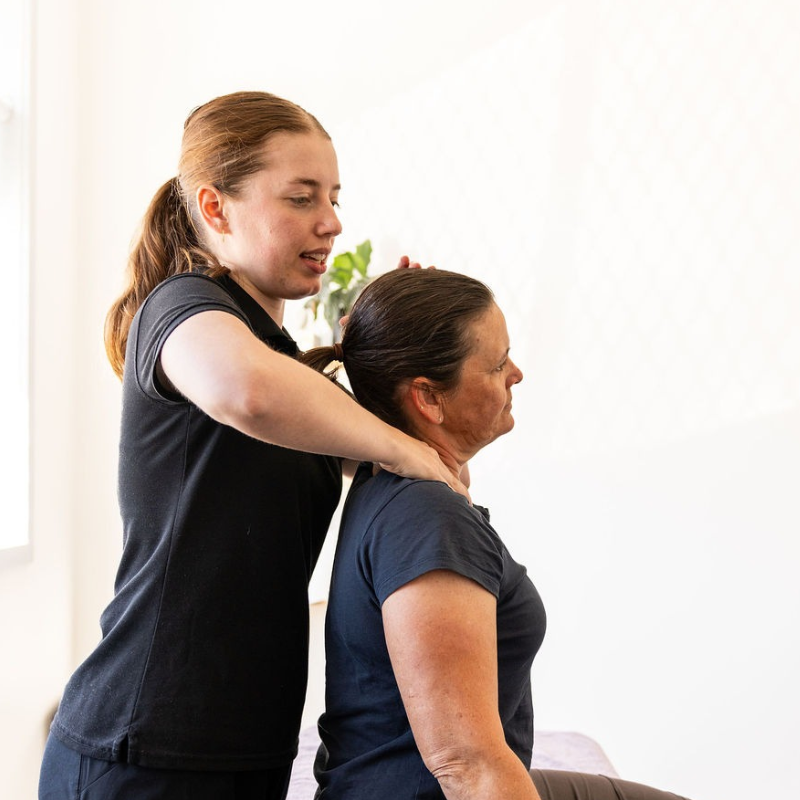
It’s a Physiotherapy or Osteopathy appointment. We talk through what’s been happening and what matters to you, explain the musculoskeletal changes of this stage of life, then objectively test your strength, balance and movement. You leave with an explanation, a measured baseline and a plan you can start, coordinated with your GP where that’s useful. If appropriate, we’ll refer you to our exercise team, and build you a personalised strength and conditioning program.
Can I keep training at my own gym?
Yes. The assessment isn’t a membership and it isn’t a condition of anything. Plenty of women take their results and their program back to their existing gym, class or trainer. What changes is that the program is now built around what your body was actually measured as needing.
Is it safe to lift heavy weights during menopause?
For most women, supervised strength training that includes heavier loading and some impact work is beneficial, and it supports bone density and strength in postmenopausal women. The skill is in the dosing: the right load, introduced properly and progressed over time. An assessment establishes what’s appropriate for you before the loading starts.
I’m already active. Is this still worth doing?
Being active is a real head start, and it isn’t a guarantee that everything is covered. Cardiovascular fitness, muscle strength and bone loading are three different adaptations to three different stimuli, and you can build plenty of one and very little of another without being able to feel the difference. Measuring it is the only way to know.
Is joint pain and stiffness in perimenopause normal?
New stiffness, aching joints and tendon pain are common through perimenopause and menopause, and they’re connected to the changes in bone, muscle, tendon and joint tissue that happen at this stage. Common doesn’t mean untreatable. It’s worth having assessed rather than worked around, particularly if it’s changing what you’re willing to attempt.